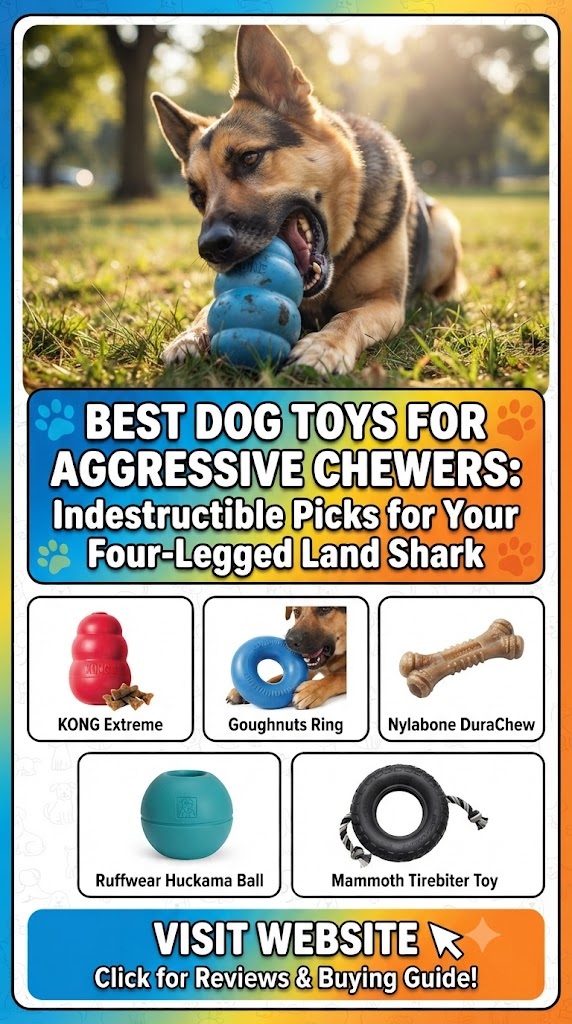
Best Dog Toys for Aggressive Chewers: Indestructible Picks for Your Four-Legged Land Shark
If you are reading this, you likely know the specific, heartbreaking sound of a $20 “indestructible” dog toy meeting its untimely demise. It starts with a frantic squeaking, followed by the sound of ripping fabric, and ends with your living room looking like a polyester snowstorm. For owners of “Power Chewers”—those dogs with jaws like hydraulic presses—finding a toy that lasts more than fifteen minutes feels like a quest for the Holy Grail.
Aggressive chewing isn’t just a habit; for many breeds, it’s a lifestyle. Whether you have a Pit Bull, a German Shepherd, a Labrador, or a Jack Russell Terrier who thinks he’s a Great Dane, the need to gnaw is primal. But beyond the frustration of wasted money, the wrong toy can be a genuine safety hazard.
In this comprehensive guide, we are diving deep into the world of heavy-duty dog toys. We will explore the science of why dogs chew, the materials that actually hold up under pressure, and a curated list of the absolute best dog toys for aggressive chewers on the market today.
The Psychology of the Power Chewer: Why Do They Do It?
Before we look at the hardware, we need to understand the “software.” Why does your dog feel the need to reduce a solid rubber ball to dust?
1. The Biological Instinct
Chewing is a natural behavior inherited from wild ancestors. In the wild, canines chew on bones to get to the marrow and to keep their teeth clean. Domestic dogs still have this urge. It’s a way for them to explore their world and keep their jaw muscles strong.
2. Stress and Anxiety Relief
For many dogs, chewing is a self-soothing mechanism. The act of repetitive gnawing releases endorphins in a dog’s brain, helping them calm down. This is why many dogs become “destructive” when their owners leave for work—they are literally trying to chew their way out of anxiety.
3. Boredom
A bored dog is a creative dog, and you usually won’t like their creativity. If a high-energy breed doesn’t have a job to do or a puzzle to solve, they will find a job. Usually, that job is “Disassemble the Couch.”
4. Teething and Dental Health
Puppies chew to relieve the discomfort of new teeth coming in. Adult dogs chew because it’s nature’s toothbrush. The friction of chewing helps scrape away plaque and tartar, though this only works if the toy is appropriate and safe.
Material Matters: What Makes a Toy “Indestructible”?
When shopping for an aggressive chewer, the packaging will often lie to you. Words like “Tuff,” “Strong,” and “Guaranteed” are thrown around loosely. To find a truly durable toy, you have to look at the material composition.
Natural Rubber
This is the gold standard. High-quality natural rubber is puncture-resistant and has “give.” When a dog bites down, the rubber compresses rather than snapping. Look for “solid” rubber rather than hollow shells unless the walls are exceptionally thick.
Solid Nylon
Nylon toys (like those from Nylabone) are extremely hard. They are designed for dogs who like to “gnaw” rather than “crunch.” As the dog chews, the nylon develops tiny bristles that help clean teeth. However, if your dog tries to snap the toy in half with their back molars, nylon can sometimes be too hard and cause tooth fractures.
Kevlar and Fire Hose Fabric
For dogs who love “soft” toys but destroy plushies, Kevlar or multi-layered fire hose materials are the go-to. These are often reinforced with cross-stitching and lack the “weak points” like ears, limbs, or loose tails that dogs love to target.
Specialized Thermoplastic Elastomers (TPE)
Brands like West Paw use proprietary TPE blends (like Zogoflex) that are recyclable, dishwasher safe, and surprisingly durable. They provide a “squishy” feedback that many dogs find satisfying without tearing easily.
The “Wall of Fame”: Best Overall Toys for Aggressive Chewers
After testing, reviews, and feedback from thousands of “land shark” owners, these are the toys that consistently survive the gauntlet.
1. The KONG Extreme (The Black One)
You cannot have a conversation about durable dog toys without mentioning the KONG. While the classic red KONG is great for average chewers, the KONG Extreme (Black) is designed specifically for power chewers.
- Why it works: Its unique shape makes it bounce unpredictably, providing mental stimulation. Its hollow center allows you to stuff it with peanut butter, kibble, or treats, turning a chew toy into a long-lasting puzzle.
- Pro Tip: Fill it with wet food or yogurt and freeze it overnight. This can turn a 10-minute chew session into an hour-long brain workout.
2. Goughnuts Rings
Goughnuts is a company founded by mechanical engineers. Their philosophy is simple: if a dog can get through to the inner layer, the toy is no longer safe.
- The Safety Indicator: Goughnuts feature a “Safety Indicator” layer. The exterior is one color (usually black, green, or orange), and the interior core is red. If your dog chews through to the red, you stop using the toy and send it back to the company for a replacement.
- Durability: These are arguably the toughest rubber toys on the planet. They are heavy, solid, and designed to withstand incredible PSI.
3. West Paw Zogoflex Hurley
The Hurley is a simple, bone-shaped toy that defies logic. It looks like it should be easy to destroy, but the Zogoflex material is incredibly resilient.
- The Perks: It floats, it’s dishwasher safe, and it’s surprisingly gentle on the gums while being tough against teeth.
- The Guarantee: West Paw offers a one-time replacement or refund if your dog manages to destroy the toy. This “Love It Guarantee” makes it a low-risk investment for skeptical owners.
4. Monster K9 Indestructible Dog Ball
If your dog is a “ball is life” fanatic but pops tennis balls like they are bubbles, you need the Monster K9.
- Material: Made from a proprietary industrial-grade rubber compound.
- Safety: It is non-toxic and larger than a standard tennis ball, which reduces the risk of accidental swallowing or choking in larger breeds like Mastiffs or Rotweillers.
5. Nylabone DuraChew Textured Ring
For the “gnawers” who prefer hard textures over rubbery ones, the Nylabone DuraChew is a classic.
- Design: The ring shape is harder to get a “leverage bite” on than a straight bone, making it last longer. The textured surface is excellent for scraping away dental tartar.
- Flavoring: These are often infused with allergen-free scents like bison or chicken to keep the dog engaged.
Interactive Toys: Engaging the Mind of a Destroyer
Aggressive chewing is often a symptom of boredom. If you can tire out your dog’s brain, they will have less energy to devote to destroying their toys.
The StarMark Bob-A-Lot
This is a heavy-duty plastic toy that wobbles and tips, dispensing treats as the dog knocks it around. While it is made of hard plastic, the weighted bottom makes it difficult for dogs to get their jaws around it to crunch it. It forces them to use their paws and nose rather than just their teeth.
The Jolly Ball (Romp-n-Roll)
Originally designed for horses, the Jolly Ball is a giant, heavy-duty ball with a rope through it. It is meant for “punishing” play. Dogs can kick it, chase it, and tug the rope. Because the ball is made of a self-healing material, even if the dog punctures it, the ball won’t deflate.
Safety First: What to Avoid
Not all “tough” toys are safe. In fact, some of the most popular items sold in pet stores are dangerous for aggressive chewers.
1. Tennis Balls
Standard tennis balls are essentially covered in industrial-grade sandpaper. The yellow felt is highly abrasive. For a dog that carries a ball constantly or chews on it, this felt can wear down the enamel on their teeth (a condition known as “blunting”). Furthermore, the rubber core of a cheap tennis ball is easy to split, creating a choking hazard.
2. Rawhide
Rawhide is a byproduct of the leather industry. For aggressive chewers, it’s a nightmare. They can tear off large chunks and swallow them whole. Rawhide does not digest easily; it swells in the stomach and can cause fatal intestinal blockages.
3. “Indestructible” Plushies with Squeakers
There is no such thing as an indestructible plush toy for a dog determined to find the “heart” (the squeaker). Once the fabric is breached, the polyester stuffing becomes a choking hazard or a cause for bowel obstruction.
4. Cooked Bones
Never give your dog cooked bones from your dinner table. Cooking makes bones brittle. An aggressive chewer will splinter a cooked bone into shards that can puncture the esophagus, stomach, or intestines.
How to Make Your Dog’s Toys Last Longer
Even the toughest toys need a strategy to survive. Here are some expert tips to extend the life of your investment:
- Toy Rotation: Don’t leave all the toys out at once. If a dog has access to the same toy 24/7, they will eventually find a weak spot. Leave two toys out and rotate them every few days to keep the “novelty” alive.
- Supervised Play: When you introduce a new toy, watch your dog closely for the first 30 minutes. See how they are chewing it. If they are focusing on one specific corner or seam, take it away and redirect them.
- The “Two-Finger” Rule: For rubber toys, if you can’t indent the surface slightly with your thumbnail, the toy might be too hard and could crack a tooth. If you can easily pinch a piece of the rubber off, it’s too soft.
- Size Up: When in doubt, buy the larger size. A dog has less jaw leverage on a toy that is slightly too big for their mouth than on one that fits perfectly between their back molars.
The Economics of Durable Toys: Why Expensive is Actually Cheaper
It is tempting to grab a $5 toy at the grocery store checkout. However, if your dog destroys that toy in 10 minutes, you are paying $0.50 per minute of entertainment. A $30 Goughnut or KONG Extreme that lasts two years costs less than $0.05 per day.
Moreover, the average cost of emergency surgery to remove a toy obstruction from a dog’s stomach ranges from $2,000 to $5,000. Investing in high-quality, vet-approved materials isn’t just about saving money on toys; it’s about protecting your dog’s life and your savings account.
Breed-Specific Recommendations
Different breeds have different “chewing styles.” Matching the toy to the breed can lead to better results.
The Pit Bull and Staffy (The “Crushers”)
These dogs have incredible jaw strength and tend to try and “pop” toys.
- Best Bet: Solid rubber rings (Goughnuts) or the Monster K9 Ring. Avoid hollow toys that can be compressed and split.
The German Shepherd and Belgian Malinois (The “Precision Strippers”)
These breeds are intelligent and use their front incisors to “pick” at seams or small protrusions.
- Best Bet: Seamless toys like the West Paw Hurley or the KONG Extreme. Look for items with no “start points” for their teeth.
The Labrador and Golden Retriever (The “Obsessive Carriers”)
Retrievers love to have something in their mouth at all times. They often “mouth” toys for hours, which can slowly wear them down.
- Best Bet: The KONG Flyer (Extreme version). It’s a durable frisbee that satisfies their carrying instinct but stands up to the occasional gnaw session.
The Jack Russell and Terriers (The “Shredders”)
Don’t let their size fool you. Terriers were bred to shake and kill vermin. They will try to “kill” a toy by shaking it violently.
- Best Bet: Fire hose tug toys or the Zogoflex Bumi. These allow for that “shaking” motion without falling apart.
Maintenance: Keeping the Survivors Clean
Durable toys are built to last, but they can become breeding grounds for bacteria.
- Dishwasher: Most high-end rubber toys (KONG, West Paw) are top-rack dishwasher safe. Running them through a cycle once a week removes dried saliva and bacteria.
- Vinegar Soak: For toys with deep crevices, soak them in a 50/50 mixture of water and white vinegar to break down grime.
- Inspect Regularly: Every week, perform a “stress test” on the toys. Pull on them, squeeze them, and look for tiny cracks. At the first sign of a piece “flaking” off, it’s time to retire the toy.
DIY for Power Chewers: Is it Possible?
Most DIY dog toy “hacks” (like tying knots in old t-shirts or putting a water bottle in a sock) are a disaster for aggressive chewers. They will swallow the fabric or the plastic cap in seconds.
The only safe DIY for a power chewer is the “Frozen Knotty Towel.”
- Take an old, thick beach towel.
- Tie it into several very tight knots.
- Soak it in water (or low-sodium chicken broth).
- Freeze it solid. This provides a cold, crunchy, and durable chewing experience that is great for teething or hot summer days. However, this should only be done under supervision, as the towel will eventually thaw and become shreddable.
Conclusion: Investing in Your Dog’s Happiness
Being the owner of an aggressive chewer can be frustrating, but it’s important to remember that chewing is a sign of a healthy, energetic dog. By providing them with the right outlets for their energy, you aren’t just saving your furniture—you are improving their quality of life.
The “Perfect Toy” varies from dog to dog, but by sticking to high-quality natural rubber, solid nylon, and reputable brands like KONG, Goughnuts, and West Paw, you are giving your “land shark” the best chance at a long-lasting, safe play experience.
Stop wasting money on “fluff” and start investing in gear that is as tough as your dog. Your wallet, and your dog’s tail, will thank you.
Quick Summary Checklist for Your Next Shopping Trip:
- Material: Is it Natural Rubber or Solid Nylon?
- Weight: Does it feel heavy and dense, or light and hollow?
- Brand: Does the company offer a replacement guarantee?
- Size: Is it large enough that it cannot be swallowed?
- Texture: Does it have “give” to protect the teeth?
Happy Chewing!